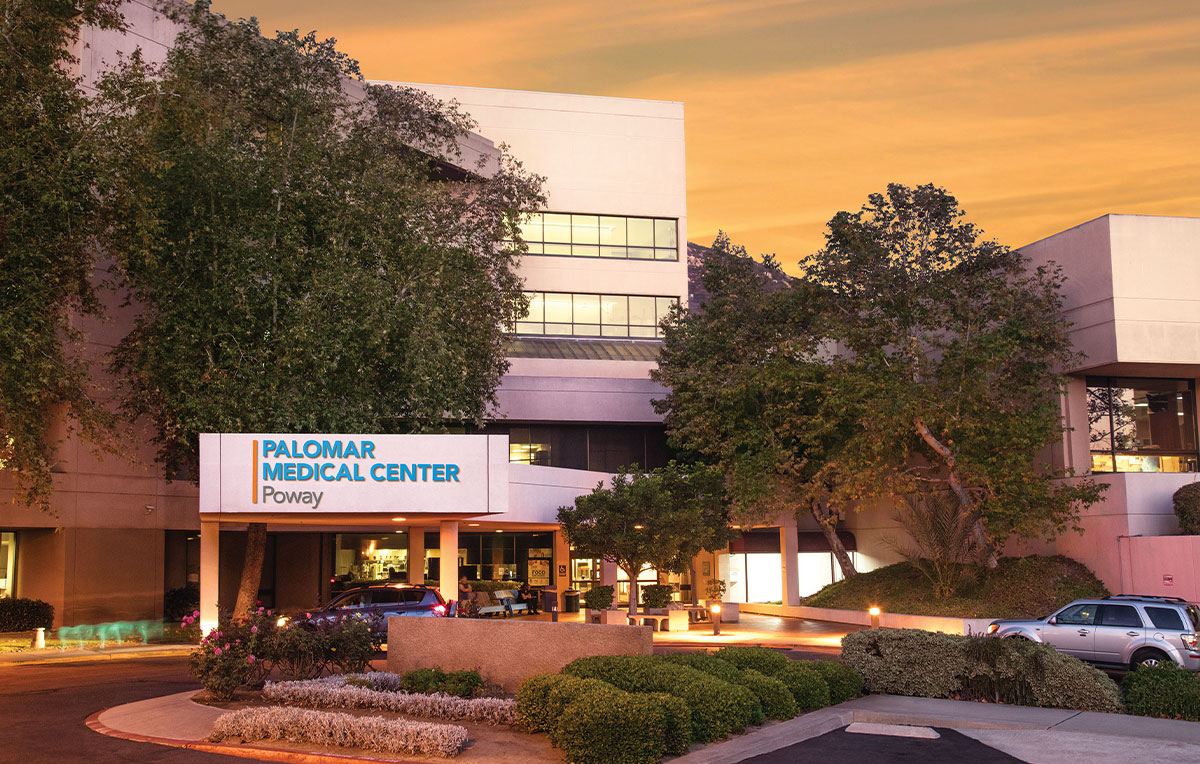
Stroke Center of Excellence
Palomar UC San Diego Health has been recognized by the Joint Commission and the American Heart Association for world-class stroke care, and has been recognized by Healthgrades as America’s 100 Best for Stroke Care.
For a patient experiencing a stroke, it is critical for to act quickly. Stroke is a medical emergency and can only be treated at a hospital. It is important to understand the warning signs and symptoms of a stroke so that you or a loved one can act quickly. Click here to learn more about strokes and stroke prevention.
High-Quality Care With Excellent Patient Outcomes
Palomar UC San Diego Health has earned the Gold Seal of Approval from the Joint Commission for both Palomar UC San Diego Health Escondido and Palomar UC San Diego Health Poway. The Joint Commission Primary Stroke Center (PSC) two-year certification was awarded originally in 2009 to both hospitals. The advanced Primary Stroke Center Certification is current at Palomar UC San Diego Health Poway.
In 2021, Palomar UC San Diego Health Escondido earned the advanced stroke certification for Thrombectomy-Capable Stroke Centers (TSC) by meeting rigorous standards for performing endovascular thrombectomy (EVT). Palomar UC San Diego Health Escondido is current with the advanced Thrombectomy-Capable Stroke Center certification.
Joint Commission reviewers evaluated compliance with related certification standards, including:
- Demonstrating compliance with the new standards for TSC certification
- Meeting the minimum mechanical thrombectomy volume requirement
- Demonstrating the ability to perform mechanical thrombectomy 24/7
- Maintaining dedicated intensive care beds for acute ischemic stroke patients
- Meeting the expectations for the availability of staff and practitioners closely aligned with Comprehensive Stroke Center expectations
These certifications recognize Palomar UC San Diego Health’s commitment to fostering continuous quality improvement in patient safety and quality of care. Joint Commission standards are developed in consultation with healthcare experts and providers, measurement experts and patients.
Palomar Medical Center & American Heart Association

Palomar Medical Center has partnered with the American Heart Association to increase heart health awareness across the North County region. This partnership allows much-needed heart-healthy resources and education to be invested across North County, making it easier for families to live longer and healthier lives.
Palomar UC San Diego Health Poway was awarded the 2025 Gold-Plus Performance Achievement Award from the American Heart Association and American Stroke Association’s “Get With the Guidelines®” program. In addition, Palomar UC San Diego Health Poway was awarded the Target: Stroke Honor Roll Elite and the Target: Type 2 Diabetes Honor Roll. This award is based on the data from 1/1/2023 through 12/31/2024.
Thrombolytic Medication and Clot Retrieval Treatment
Palomar Medical Center offers thrombolytic medication treatment and state-of-the-art clot retrieval treatment by our Neuro-Interventional Radiology team. This technology allows doctors to pinpoint the exact location of blood clots and use drugs and/or mechanical tools to remove them.
Programs and Services
- Multidisciplinary stroke care
- 24-hour support by neurologists, neurosurgeons, interventional radiologists and other experts
- Stroke-reversing treatments, including clot-dissolving drugs and clot retrieval procedures
- Strict written protocols for patient care and ongoing reporting
- Stroke education for patients and loved ones
Stroke Quality Data
STROKE QUALITY MEASUREMENT AND OUTCOMES
A stroke is a medical emergency that requires rapid treatment — the quicker you receive care, the better your chances of survival and long-term recovery. You can also reduce your risk of serious side effects, including permanent disabilities, by seeking care from hospitals that have proven their ability to manage even the most complex stroke cases.
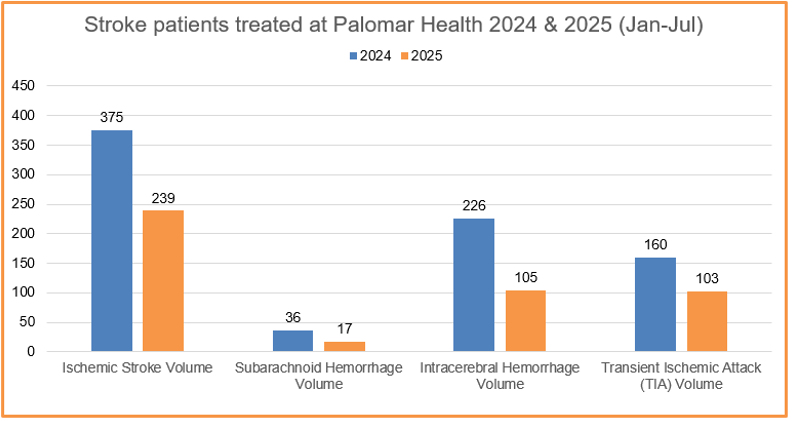
2024–2025 STROKE VOLUME
INPATIENT PERFORMANCE MEASURES
Palomar UC San Diego Health utilizes evidenced-based guidelines, endorsed by the American Heart Association and the American Stroke Association, to ensure all patients suffering from strokes receive appropriate care. At Palomar UC San Diego Health, we monitor our compliance with our stroke core measures as endorsed by the Joint Commission. The chart below highlights our performance in exceeding these measures and benchmarks against other Joint Commission-certified stroke centers.
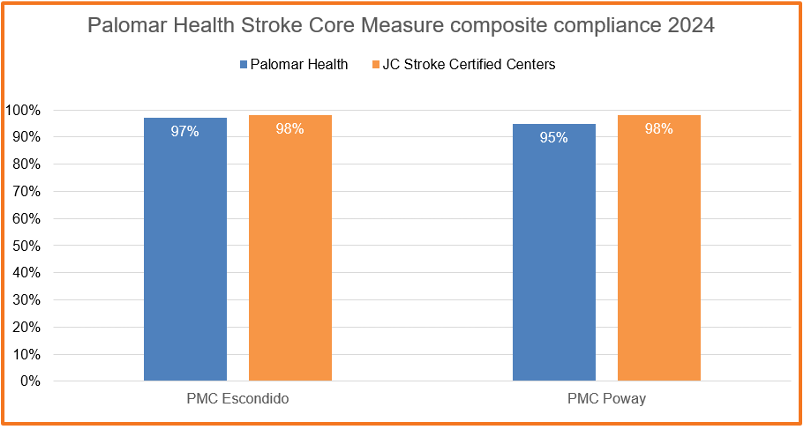
Inpatient stroke core measures include:
Venous thromboembolism (VTE) prophylaxis – The percentage of ischemic and hemorrhagic stroke patients who received a type of therapy to prevent blood clots the day of, or the day after, hospital admission.
Discharged on anti-thrombotic therapy – The percentage of ischemic stroke patients who were prescribed a type of blood-thinning medication upon discharge from the hospital.
Number of patients prescribed anti-coagulation therapy for atrial fibrillation/flutter – The percentage of ischemic stroke patients diagnosed with a heart condition called atrial fibrillation, who were prescribed a blood-thinning medication upon discharge from the hospital.
Thrombolytic therapy – Percentage of ischemic stroke patients who arrived at the hospital within two hours of stroke symptom onset, and were given a type of “clot-busting” medicine called intravenous tissue plasminogen activator (IV t-PA) within three hours of symptom onset.
Anti-thrombotic therapy by end of hospital day two – Percentage of ischemic stroke patients given a blood-thinning medication by the end of their second day in the hospital.
Discharge on statin medication – Percentage of ischemic stroke patients who were prescribed a medication to lower cholesterol upon discharge from the hospital.
Stroke education – Percentage of ischemic or hemorrhagic stroke patients (or their caregivers) who were given stroke education materials during their hospital stay.
Assessed for rehabilitation – Percentage of ischemic or hemorrhagic stroke patients who were assessed for rehabilitation needs including physical therapy, occupational therapy and speech or swallowing therapy.
Thrombolytic Treatment
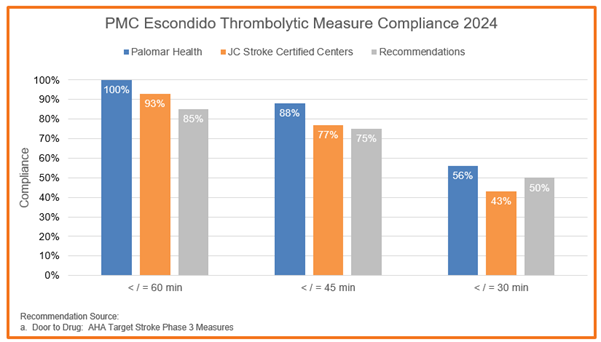
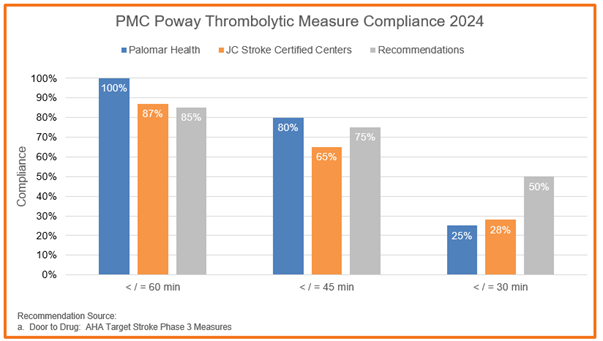
Clinical practice guidelines recommend hospitals administer a type of clot-busting medicine called Alteplase (tPA) or Tenecteplase (TNKase) to eligible ischemic stroke patients within 60 minutes of arrival.
The American Heart Association and American Stroke Association have provided the Target Stroke Phase 3 Measures to improve outcomes for patients who receive thrombolytic treatment.
- Primary treatment goal includes administration of thrombolytic treatment
- Within 60 minutes from arrival 85% of the time
- Secondary treatment goals include administration of thrombolytic treatment
- Within 45 minutes from arrival 75% of the time
- Within 30 minutes from arrival 50% of the time
In 2024, Palomar UC San Diego Health adopted the Target Stroke Phase 3 Measures to continue to improve patient outcomes. The following graphs show how Palomar UC San Diego Health Escondido and Palomar UC San Diego Health Poway did with the new Target Measures for Thrombolytic Treatment.
Endovascular Treatment
Effectiveness of endovascular procedures
Ischemic strokes are caused by a blockage in one of the arteries that supply blood to the brain. Patients with evidence of blockage in one of the major blood vessels in their brain, who present within 24 hours from the onset of their stroke, can be treated with a catheter-based approach. This endovascular treatment immediately restores blood flow, captures the blood clot and removes it from the blood vessel.
Thrombolysis in cerebral infarction (TICI), post-treatment reperfusion grade
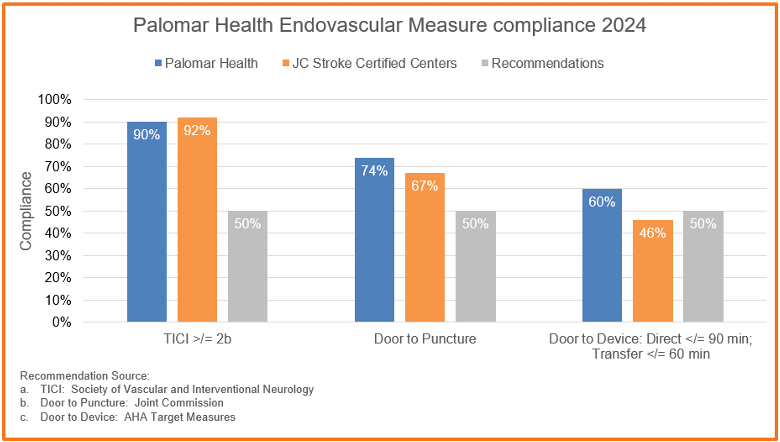
Many hospitals use a scale called thrombolysis in cerebral infarction (TICI) to evaluate the success of endovascular treatments. The more open a blood vessel is following treatment, the more easily blood can flow through it.
In 2015, the Endovascular Stroke Standards Committee of the Society of Vascular and Interventional Neurology established the following national benchmark for hospitals: At least 50 percent of ischemic stroke patients who undergo endovascular treatment must achieve a TICI grade of “2b” or higher. This means the vessel completely fills with blood, even though the rate of blood flow may be slower than normal.
Specialties
- Neurologists
- Neurosurgeons
- Interventionists
- Stroke coordinator
- National Institute of Health (NIH)-certified stroke nurses
- Stroke specialty care by physical, occupational and speech therapists
Stroke Care Doctors
- David Baker, DO – Neurology
- Bilal Choudry, MD – Neurology
- Michael W. Delaney, MD – Neurology
- William Farnsworth, MD – Neurology
- Gary Gualberto, MD – Neurology
- Richard A. Lane, MD – Neurology
- Riya Luhar, DO – Neurology
- Amy Nielsen, DO – Neurology
- Irene Oh, MD – Neurology
- Arthur Omuro, DO – Neurology
- Remia S. Paduga, MD – Neurology
- Tara Quesnell, DO – Neurology
- Gregory A. Sahagian, MD – Neurology
- Anchi Wang, MD – Neurology
- Chunyang T. Wang, MD – Neurology
- Brenton Wright, MD – Neurology
- June Yoshii-Contreras, MD – Neurology
- Sharona Ben-Haim, MD – Neurosurgery
- Andrew Nguyen, MD, PhD – Neurosurgery
- Martin Pham, MD – Neurosurgery
- David Santiago-Dieppa, MD – Neurosurgery
- Brian Hirshman, MD – Neurosurgery
- Howard Tung, MD – Neurosurgery
- Dustin Hatefi, MD – Neurosurgery
- Justin M. Gooding, MD – Interventional Radiology
- Charles McGraw, MD – Interventional Radiology
- Arian Nasiri, MD – Interventional Radiology
- Michael Noud, MD – Interventional Radiology
- Donald J. Ponec, MD – Interventional Radiology
- Richard R. Saxon, MD – Interventional Radiology
- Cyrus Shabrang, MD – Interventional Radiology
- Tyler Miskin, MD – Interventional Radiology
Locations